I only have a few of these, but they are still interesting. Amazingly, in excess of 10 million 35mm cameras were made in the old USSR. Principal manufacturers were KMZ (Zorki & Zenit), FED, GOMZ and LOMO, as well as KIEV in Ukraine.

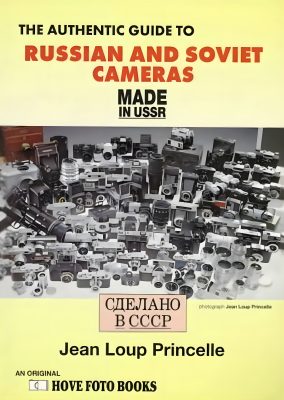
Below is my book, one of the best on this subject.

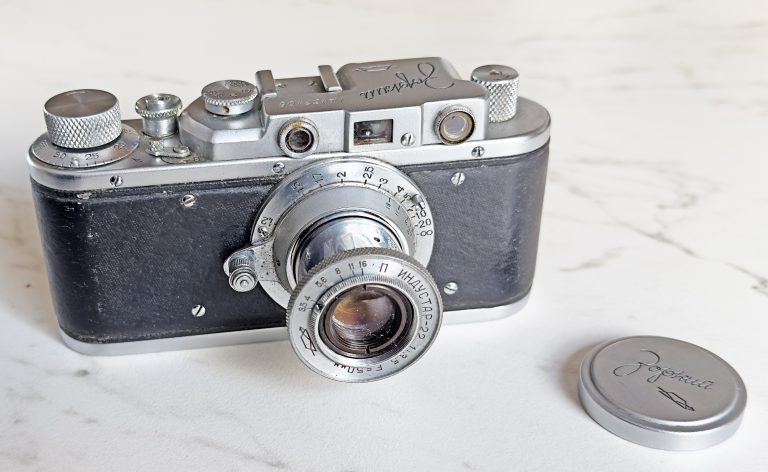
1951 ZORKI-1c

The success of the prewar Leica lead to the manufacturer of various copies, even before the Leitz patents were voided after the end of WW2. One of these was the Russian FED-1 (after Felix Edmundovich Dzerzhinsky) based on the Leica ll. The original factory in Kharkiv, Ukraine, was evacuated with the advancing German troops. After the war, due to difficulties in restarting production it was transferred to the KMZ factory near Moscow. Initially called a joint FED-ZORKI (Zorki is Russian for “sharp sighted”) it became just ZORKI after the FED factory was reinstated.

Leica copies proliferated after 1945 when the Leica’s original patents for its cameras and lenses, along with countless other German pre-war patents across many industries, were voided by the French and American occupational forces.

My ZORKI-1c is quite basic in specification having speeds from 1/20th to 1/500th and Z (B), so no slow speeds. There is no self timer and the rangefinder operates from a separate viewfinder. The lens is a collapsible Industar-22 50mm f/3.5 similar in appearance to the German Elmar, although optically based on the Zeiss Tessar.

Over 800,000 Zorki cameras were made.

1957 KIEV 3a

After WW2 as part of war reparations, Russia took possession of the contents of the former Contax factory in Dresden, East Germany and moved them to Arsenal, Ukraine to continue the production of the famous Contax.

The Kiev IIIa is a true Contax III copy and the second Kiev model equipped with a light meter. It was made in the mid to late 1950’s.
Kiev-3a is identical to the original Kiev III – it still features a stabilizing foot on the bottom plate and a tall, Contax III type light meter.
 
The specifications are the same as Contax III’s:-
 
Shutter speeds: B, 1/2 – 1/1250
Rangefinder base: 90 mm
Lens: coated Jupiter-8, f = 5 cm, 1:2, coated, a copy of Zeiss Sonnar.
Flash synch
Self-timer
 
The Kiev IIIa is much less common than its successors .

The light meter is not coupled. The “a” in the model name does not indicate, as I originally thought the presence of the meter, my other Kiev is also designated a “a” and it has no meter!

1960 Zenit C

This delightful and surprisingly small 35mm SLR is the second model in the Zenit camera line, following only three years after the original Zenit 1. It was made by Krasnogorskii Mekhanicheskii Zavod (Krasnogorsk Mechanical Works) near Moscow, between 1955 and 1961.

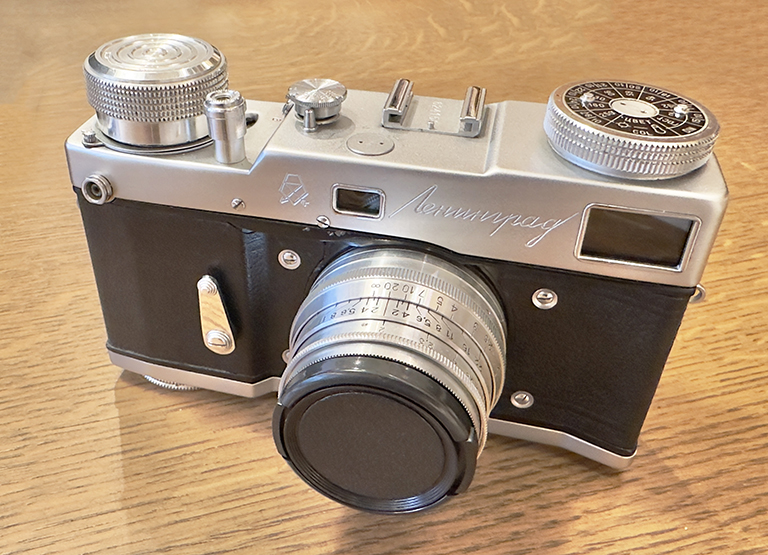
1962 LENINGRAD

The Leningrad (Ленинград) is an unusual Soviet 35mm rangefinder camera, manufactured by the GOMZ factory.  GOMZ is short for Gosudarstvenniy Optiko-Mekhanicheskii Zavod which translates to State Optical-Mechanical Factory.  Established in 1914, it transitioned to optical production in 1930 as one of the first Soviet factories to produce cameras and lenses. 

The camera, designed by Ilya Grigoryevich Shapiro who was responsible for several other cameras, featured a unique spring motor advance, permitting rapid shooting at up to 3 frames per second, though the shutter must be released for each frame. After fully winding the spring, around 20 exposures can be taken. Film advancement and shutter cocking are exclusively managed by the spring motor.

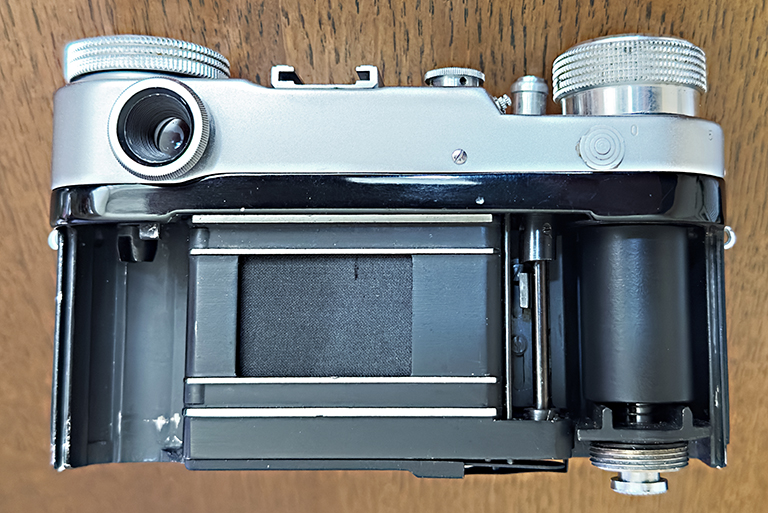
A distinctive aspect of the Leningrad is its film take-up system, which disregards 35mm sprocket holes and winds film onto a drum, causing progressively wider gaps between frames. This unconventional spacing means negatives and slides must be ordered uncut and mounted individually by users, a characteristic considered a feature rather than a flaw by enthusiasts. The camera includes an adjustment ring for flash sync timing, ranging from 5 to 20 milliseconds.

Typically supplied with a Jupiter-8 lens, the Leningrad accepts most 39mm screw lenses, though some cannot be mounted due to a protruding lip above the lens mount. Notable features include a coupled Galilean prism based viewfinder/rangefinder with bright frame lines for various focal lengths, a focal plane shutter with speeds up to 1/1,000s, a self-timer, removable back cover, a metal body weighing 850g, and serial numbers indicating production year.

Regarded as the most advanced and costly Soviet rangefinder ever made, the Leningrad was awarded the “Grand Prix de Bruxelles” at the 1958 World Exposition and used in the Soviet space programme. Only 76,000 units were made, with seven main types and four sub-types, many gifted to party members and dignitaries. Production started in 1956 and ended in 1968.
The back removed, showing the lack of film sprockets.

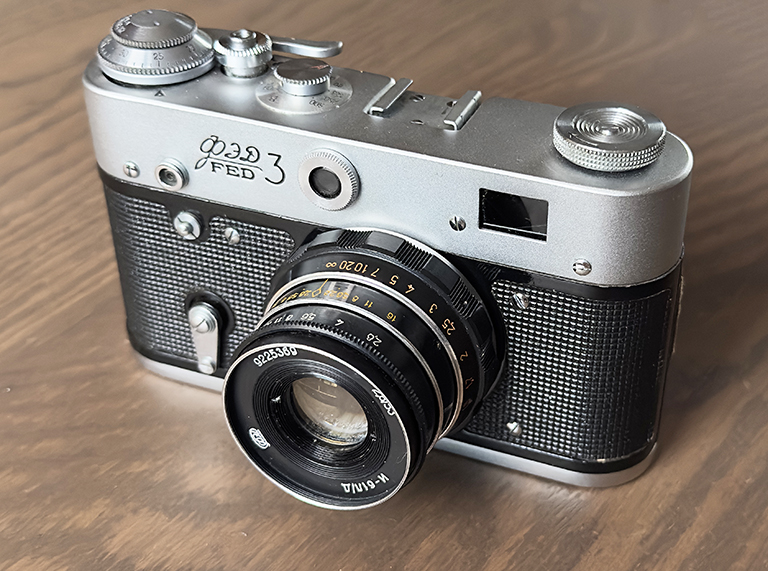
1971 FED 3

This is the third iteration of the Leica derived FED. The FED 1 was a direct Leica ll copy. The FED 2 was like my FED 3 but the rangefinder had a wider base and the there were no slow speeds. Also the rangefinder and viewfinder windows were combined. The FED 3 had the rangefinder base shortened to make room for the slow speed mechanism.

I prefer the look of the FED 2 but I couldn’t find a mint example at a low price! This one, from Poland, is like new! The legendary Industar 55mm f/2.8 L/D lens is fitted. According to Casual Photophile ” it is one of the finest pieces of glass ever manufactured in the Soviet Union”.

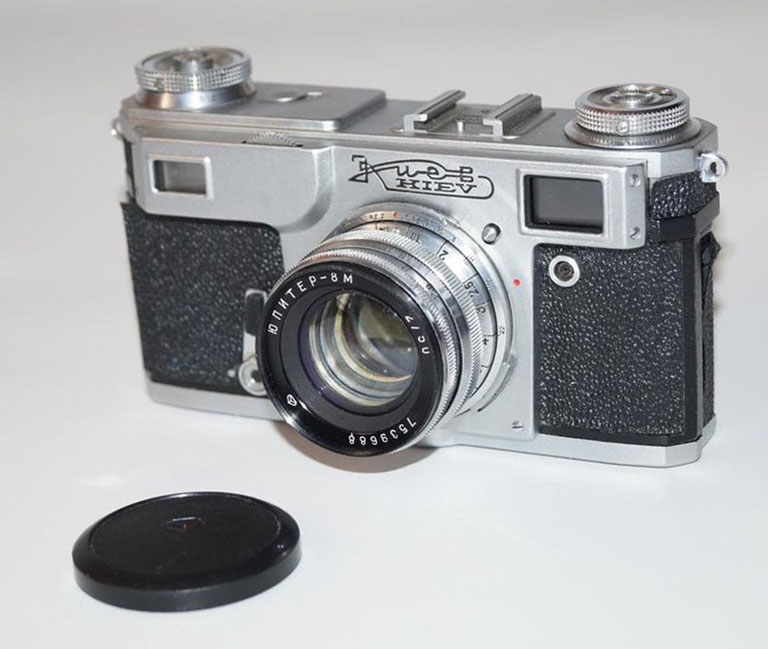
1975 KIEV 4a

According to Wikipedia :-

“These cameras are the most common type, and were sold all over the world.

It is equipped with a Jupiter 8M 50mm F2 (based on the Carl Zeiss Sonnar lens) and speeds are from 1/2 to 1/1250s.
 

LOMO LC-A

The LOMO LC-A (Lomo Kompakt – Automat) is a fixed lens, 35 mm film, leaf shutter, zone focus, compact camera introduced in 1984 and manufactured in St. Petersburg by Leningrad Optics & Mechanics Association (LOMO). The design is based on the Cosina CX-2. Some LC-As were sold badged as Zenith, this label was only a sticker underneath the lens. Production in Russia ceased in 2005, being transferred to China (the LC-A+). Thanks to Rob Tarrant for giving me this camera. LOMOs have a strong following (there is a thriving Lomographic Society International!)