France, while not immediately associated with camera manufacturing, played a pivotal role in the history and development of photography. The French invented photography, starting with Joseph Nicéphore Niépce’s first photograph in 1826 and Louis Daguerre’s practical daguerreotype process in 1839, which led to the first commercially successful cameras. French innovators also preceded German makers with early motor-driven and 35mm cameras, such as Le Pascal (1899) and the Debrie Sept (1922), which could function as both still and cine cameras.
French camera design was notable for unique jumelle (binocular-inspired) models and creative mechanisms for plate handling, as seen in the Photo-Jumelle Binocular Camera and Bellieni Jumelle Simple. France was also prolific in stereo photography, with Jules Richard producing a wide range of stereo cameras, including the versatile Glyphoscope and the Monobloc, which could switch between stereo and panoramic modes.
Foca cameras, produced by OPL, offered genuine alternatives to Leica and Contax, introducing innovative features like close-focusing systems and unique depth of field scales. SEM, another French company, made compact 35mm and twin lens reflex cameras, including the Babysem and the Semflash, the latter marketed as a home studio for families.
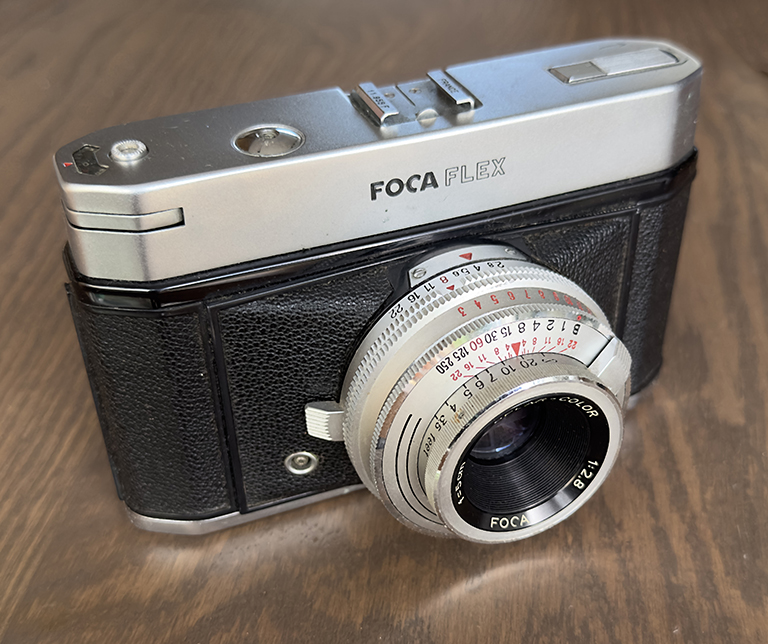
French contributions to single lens reflex (SLR) cameras included the Focaflex with its unusual light path and the Savoyflex Automatic, the world’s first shutter-priority SLR. The French also produced notably unconventional designs, such as the Maton with its knuckle-duster grip and the Alsaphot Cyclope, which used mirrors to minimise body size.
In colour photography, French pioneers revolutionised the field. The Lumière brothers introduced the Autochrome in 1907, enabling single-exposure colour photographs, while Louis Dufay developed Dioptichrome technology and later Dufaycolor, the first popular colour film available in roll formats. Overall, France contributed inventions, innovative design, and major advancements in both camera technology and photographic processes.
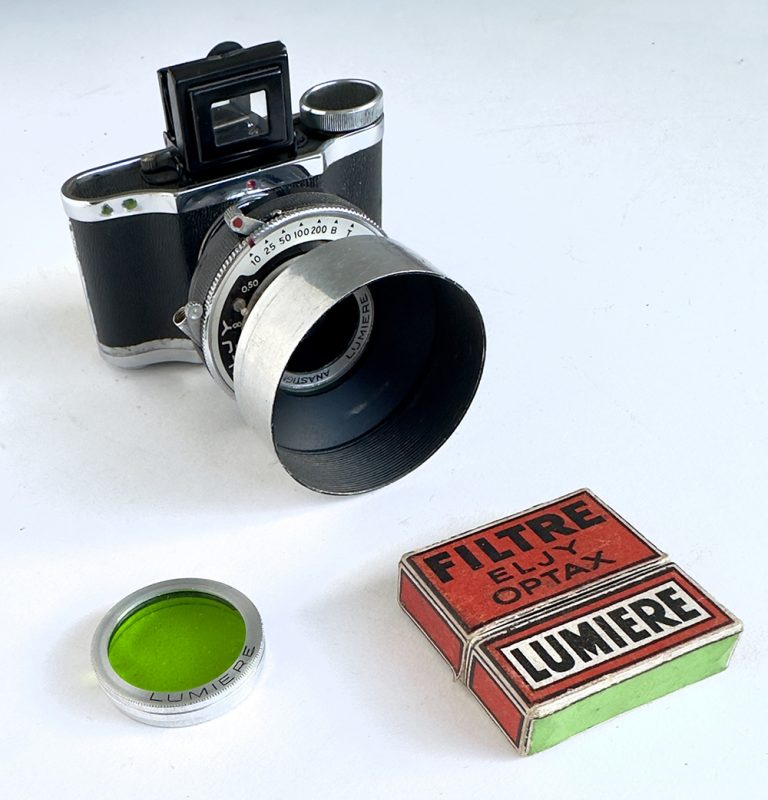
1945 Lumiere ELJY
Antoine Lumière et Ses Fils was founded by Charles-Antoine Lumière in 1883. Although the company is best known for the achievements of his children, Auguste and Louis, the original company started by making photographic plates and later cameras and films of various types.
Auguste and Louis Lumière were prolific inventors. First they invented a film plate which was much faster than those available at the time. They also invented the Cinématographe which not only recorded motion pictures but also printed and projected them (the first public cinema performance took place in 1895). It used perforated film and a claw mechanism which led to the sprocket holes still found in todays 35mm film. They also invented the first colour film process; Autochrome in 1903.
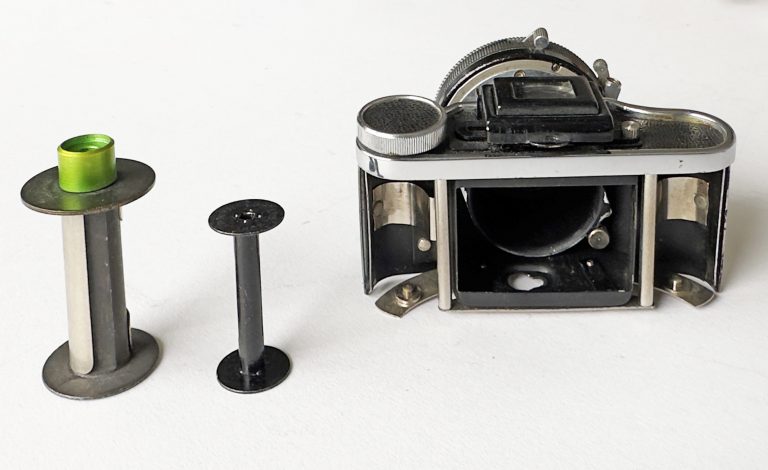
The original company started making cameras in the late 1920s until 1961 when they were taken over by the Swiss firm CIBA. Launched in 1937, The tiny Lumiere ELJY gets its name from the two locations of the Lumiere factories, Lyon and Joinville. In French the letters ‘L’ and ‘J’ are pronounced ‘EL’ and ‘JY’. The camera uses a purpose-made 24mm wide roll film, with a paper backing called ALTIPAN Eljy. The camera takes eight images 23mm x 35mm, very close to the 24 x 36mm of 35mm film but less the sprockets it is narrower. Made until the war, production continued in 1945. The various models all had the flip-up viewfinder, replaced in 1951 by the ELJY CLUB which had a more up-to-date viewfinder and also a simple extinction exposure meter,
The Gizmo shutter goes from 1/10 to 1/200th second, B and T. The 3-element Lypar lens of 50mm had a maximum aperture of f/3.5.
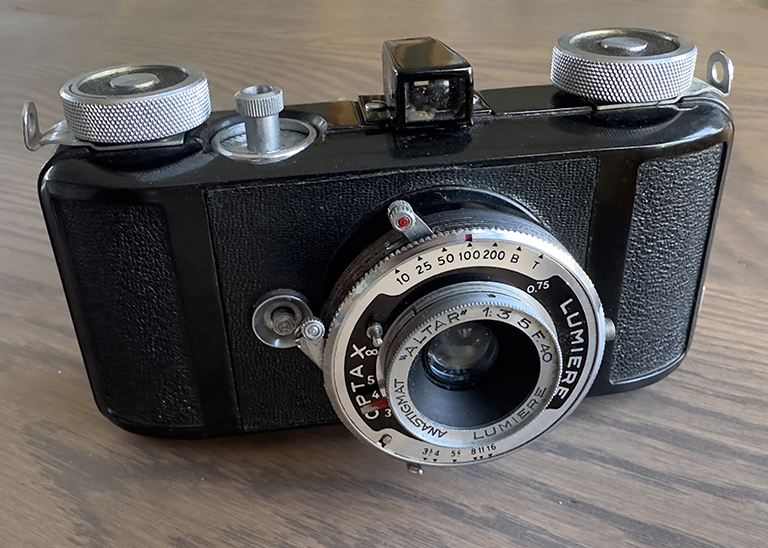
1952 Lumiere Optax III
After the war Lumiere continued producing still equipment including this interesting bakelite 35mm camera.
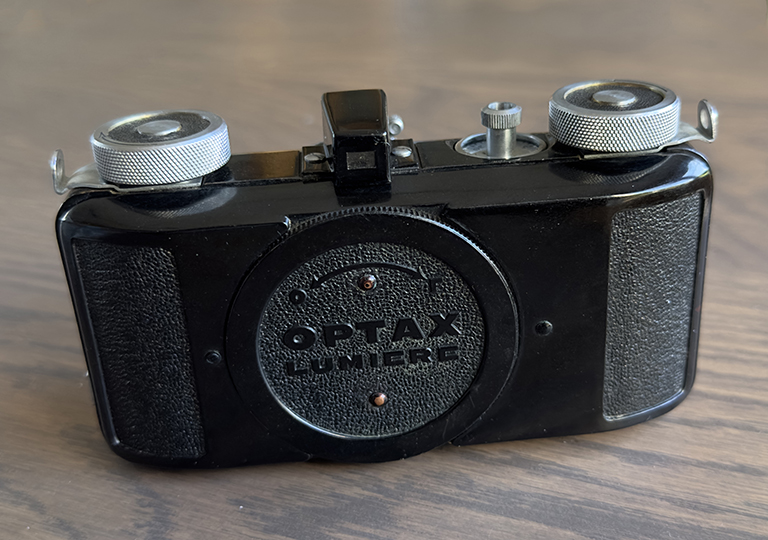
The back is unusual in that a circular disk is turned to remove it (see image below). The shutter is a Gitzo shutter providing speeds from 1/10 to 1/200 of a second + B & T. The lens is a 3-element 40mm Altar Anastigmat coated lens with a maximum aperture of f/3.5.
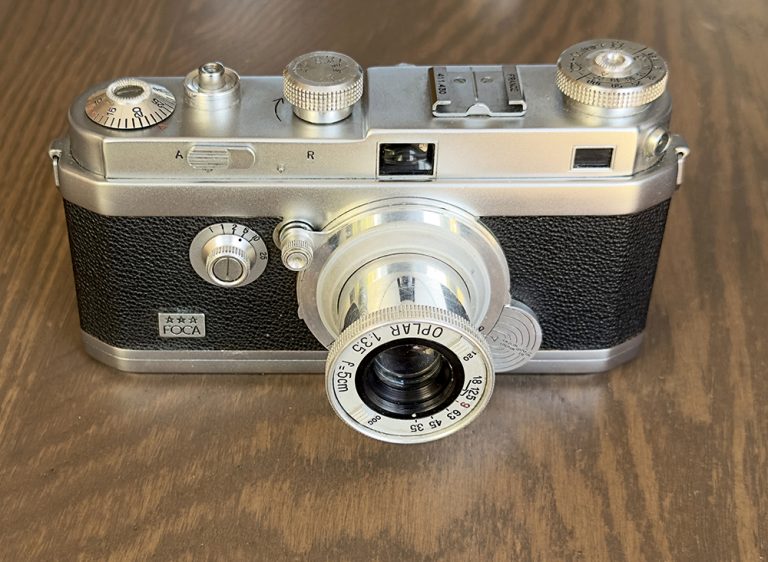
1957 FOCA FP3
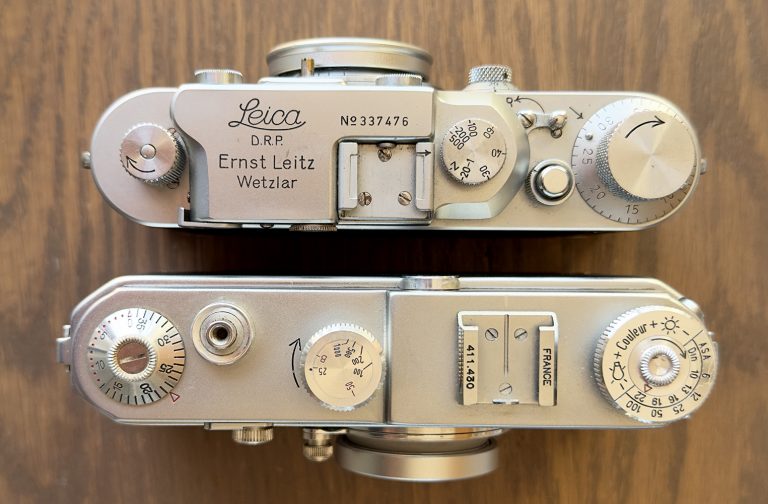
This was a French Leica “copy” made after the war. However, unlike the British Reid or the Russian FED/Zorkis it was not a copy of the Leica ll, but a unique French design.
It maintained the ubiquitous 39mm LTM with the French made OPLAR lens. The manufacturer, Optique et Précision de Levallois, otherwise known as OPL did start as an optical company making ballistic rangefinders before WW1.
The quality was high – the French photographer Willy Ronis did use these, spurning the Leicas used by his compatriot, Henri Cartier-Bresson! (Please see the “My Favourite Photographers” page).
My mint example (below) came with a ‘Leica’ lens cap to remind us of the Barnack influence!
1960 Focaflex
According to Amateur Photographer:-
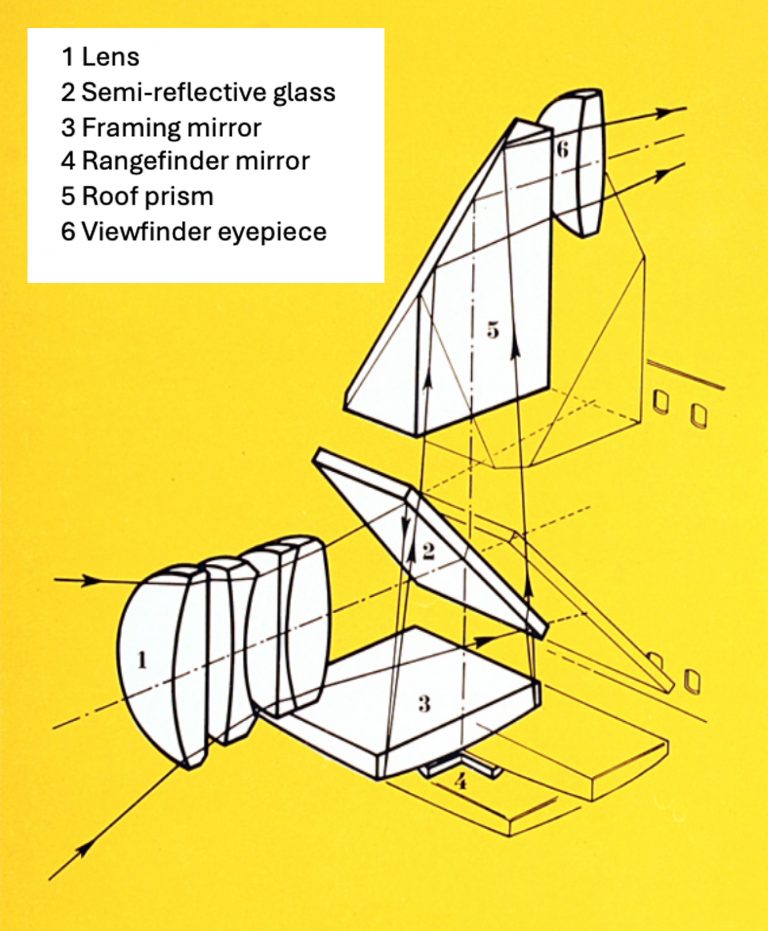
“In 1959, Foca, the company more famous for 35mm coupled rangefinder cameras, introduced the Focaflex, which used a peculiar light path into the reflex design. As the film was advanced, a reflex mirror swung up, not down in the usual way. Behind it a capping plate shielded the film from light entering the lens as the aperture iris and shutter blades opened to their widest settings for focusing. The mirror was semi-silvered to allow light to be both reflected from it and transmitted through it. Light entered the lens, hit the mirror and was reflected down to a silvered focusing screen in the base of the body. From there the image was reflected up again through the semi-silvered mirror to a small prism arrangement that turned it the right way up and right way round before reflecting it back out of the viewfinder. As the shutter was released, the aperture closed to its pre-set f-stop, the shutter blades closed and the reflex mirror plus the film-shielding capping plate swung away so that light could reach the film as the shutter opened and closed. At the same time, a blind closed over the viewfinder to prevent stray light from entering the body”.
An image of the mirror arrangement is shown. below.