There are a few photographers who I both admire and have been influenced by.
Henri Cartier-Bresson
I regard Henri Cartier-Bresson as the best photographer who ever lived! He has certainly influenced my photography – particularly my 1970s Paris photographs.
One of my favourites is the photograph below, which is called “Dimanche sur les bords de Seine” and it was taken in 1938.
To see his Wikipedia entry click
here.
W Eugene Smith
According to Wikipedia, W. Eugene Smith has been described as “perhaps the single most important American photographer in the development of the editorial photo essay.” His major photo essays include World War II photographs, the dedication of an American country doctor and a nurse midwife, the clinic of Dr Schweitzer in French Equatorial Africa, the city of Pittsburgh, and the pollution which damaged the health of the residents of Minimata in Japan (now made into a film with Johnny Depp as Smith). His 1948 series, Country Doctor, photographed for Life Magazine is now recognised as “the first extended editorial photo story”.
He dedicated his life to photography, perhaps in a way no other photographer has. He used Minoltas, as the Japanese firm gave him a SR-T-101 camera to use. To see his Wikipedia entry click here.
The picture above is from his “Country Doctor” photo essay published in Life magazine in 1948.
Roger Deakins
Roger Deakins CBE, ASC, BSC was an amateur photographer from Devon who went to Art College. From the National Film School he went on to become one of the world’s foremost Cinematographers, whose main body of work was with the Coen Brothers. To visit His personal website click here. He has won, and been nominated for several Oscars for his cinematography.
The image below is from the Beaford Archive, to which he contributed together with James Ravilious (brother of celebrated artist Eric). This is a body of work capturing life in North Devon in the 1970s and 80s. Roger took this while a student in the early 1970s. To visit this Archive click here.
James Ravilious
As mentioned above, after Roger Deakins, James Ravilious became the contributor to the Beaford Archive.
The Archive’s beginning can be dated to 1971, when cinematographer Roger Deakins spent a year taking photographs around north Devon. He went on to study at the National Film School and at Beaford he was followed by the appointment of photographer James Ravilious in 1972.
For seventeen years James Ravilious documented the people and places of North Devon, amassing a collection of over 78,000 images. He lived in the community he photographed, and was trusted to photograph all aspects of local life. In addition, working closely with his colleague George Tucker, he built what they called the ‘Old Archive’: over 5,000 copy photographs dated between 1870 and 1940, borrowed from local people.
The image below is of Dr Richard Westcott visiting a patient at South Molton Cottage Hospital in 1984. Prints of this can be purchased from the archive by clicking here.
Denis Thorpe FRPS
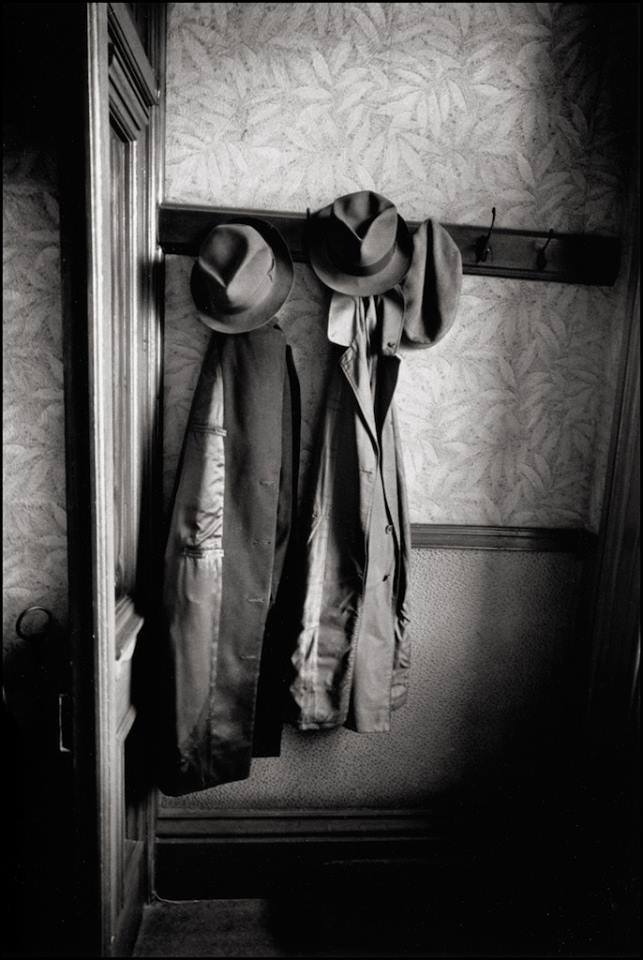
Just after I became Programme Secretary of Chester Photographic Society I saw an article in the Guardian about their staff photographer passing Lowry’s house in Salford, shortly after he had died. Seeing a removal van, Denis asked if they could wait for a few moments so he could record Lowry’s house as it was on his death. I immediately asked him to come to the Society, show his images, and talk about this experience. I later bought his book “On Home Ground”. I think Denis is an amazing photographer and I took similar photographs of my Dads home after he died.
Lowry's hats and coats.
Philip Jones-Griffiths
I never met PJ-G although I knew a fellow Liverpool Pharmacy student, Clive Owens who loved in West Kirby. He often talked about him back in the sixties before his later fame. Finally I had an opportunity to meet him at a RPS Lancaster event where he was due to give a talk. I took along my first edition of his influential book, Vietnam Inc. to sign, but sadly he didn’t turn up.
A member of Magnum, he was their president from 1980 to 1985.
Born in North Wales, he died in 2008. His seminar book perhaps helped to end the Vietnam War. According to Wikipedia “After becoming aware of his terminal condition in 2001, Jones Griffiths launched a Foundation to preserve his archives. As trustees, his two daughters helm the Foundation. In 2015, the National Library of Wales in Aberystwyth acquired the entire Philip Jones Griffiths archive, which includes approximately 150,000 slides and 30,000 prints”.
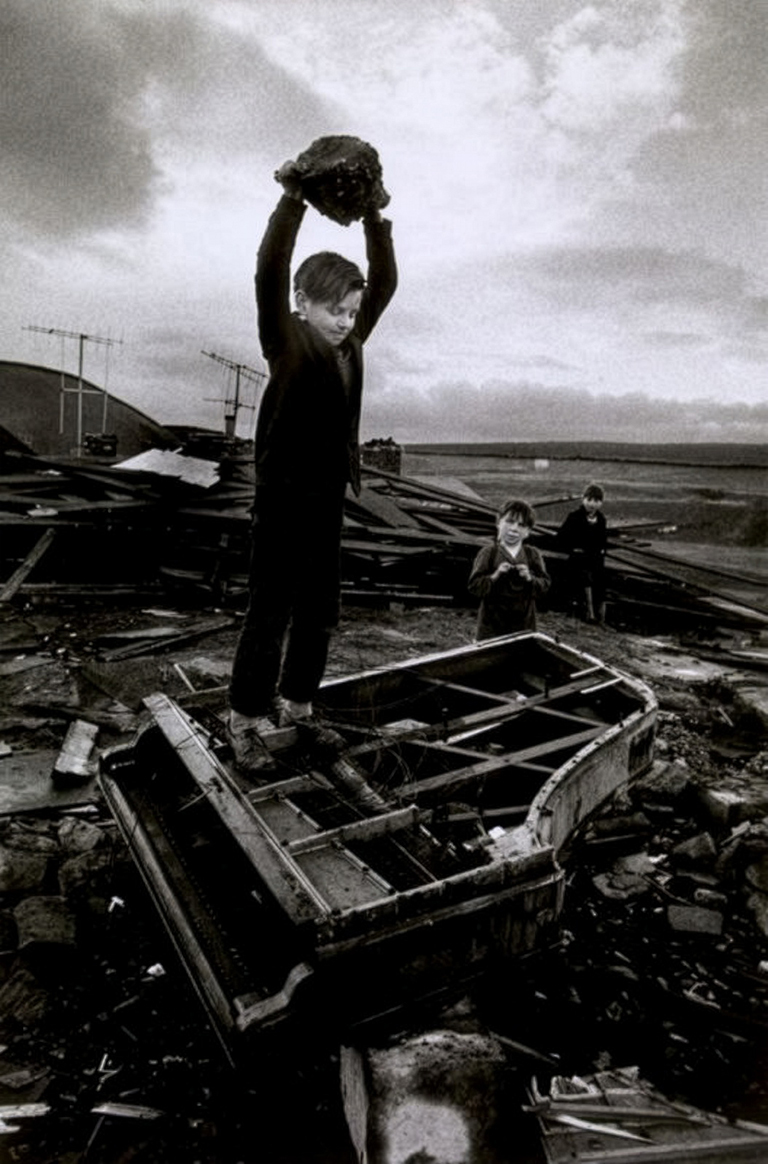
The image below (my favourite) is entitled “Boy Destroying Piano”.
John Faleur ARPS
I can’t list my favourite photographers without mentioning my late father. His best photography was done during a dream holiday in Antarctica, and he obtained his ARPS with images from this trip including the picture below.