Germany was famous for its cameras, particularly in the 1930s, 1940s and 1950s. The quality of brands such as Leica, Zeiss and Voigtlander was legendary. However after WW2 the Japanese, with their vastly improved, and innovative quality control started by copying many German cameras (helped by the cancellation of German patents). Eventually, with the introduction of SLRs, they began to dominate the market. Today, Leica is virtually the only survivor.
1921 Erneman Bob 00 1505
This
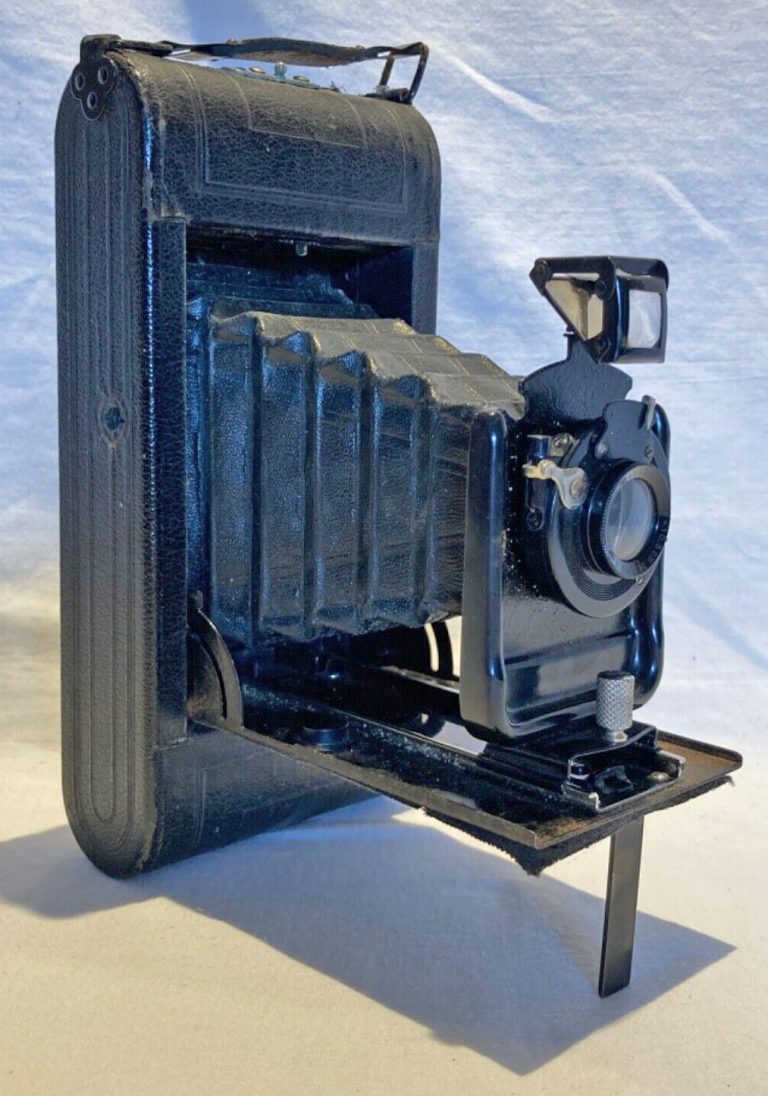
1921 KW Patent Etui
KW or Kamera Werkstatten Guthe & Thorsch was a partnership founded around 1918/1919 by Paul Guthe and Benno Thorsch. Their first camera was called the ‘Patent Etui’ (etui is German/French for ‘small case’). The name comes from the fact it folds into quite a small package.. For a plate camera taking quarter plates (9cm x 12cm) folding down to a package measuring only 9cm x 12.5cm x 1.5cm is no small achievement. Of the two founders Paul Guthe was the designer, while Benno Thorsch was the businessman.
Paul Guthe, who was established as a camera repairer and photographer before joining up with Benno Thorsch, was trained by Ernemann, then established camera makers in Dresden. He designed the Patent Etui camera in 1912 and it was patented in 1920.,first in Germany and later in the UK. He suffered ill health and left the partnership in 1930, dying later in the same year, replaced by Thorsch’s brother Julius.
The Patient Etui was launched at the Leipzig Fair in September 1920. My 1921 example, which is beautifully made and in remarkable condition, is fitted with a Vario shutter with a three speeds of 1/25, 1/50, 1/100th, B & T. Vario shutters were made by Gauthier of Calmbach, leading shutter makers in Germany. Their other shutters were the Ibsor, Pronto and Prontor. The Vario was made from 1912 to 1929. According to Camers-Wiki “the early Vario is a 2-blade dial-set type. It is also an everset type so the tensioning and release of the shutter are performed with the same lever”. The lens on mine is a Jos Schneider & Co Radionar f/4.5 105mm, although various other lenses were fitted. Sands, Hunter, & Co. Ltd whose plate adorns this example were manufacturers of photographic products in London who also worked as a dealer for other brands as well as used equipment. The company was still in business until the late 1950s. As they only imported the Etui from 1928, this early example must have been sold as a used example.
Around 90,000 of these cameras were made up to 1938, so it was definitely a success. However, given these numbers, it is a rarity today.
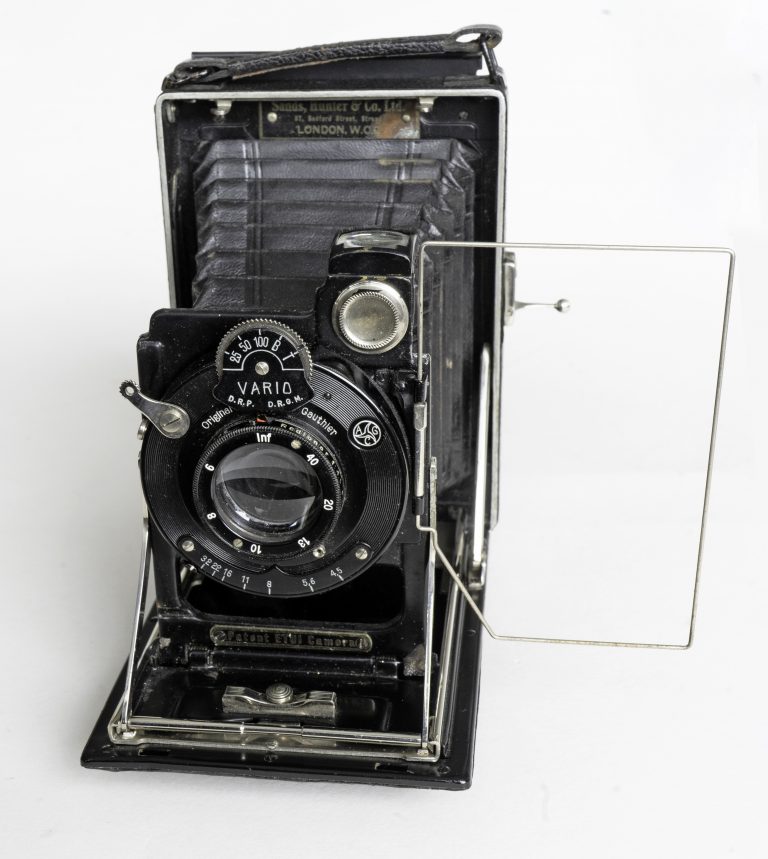
1924 Contessa Nettel Cocarette
According to Camera-Wiki “The Cocarette was a non-self erecting folding camera for rollfilm. It was one of the first new products of the German camera maker Contessa-Nettel after the merger that led to the foundation of that company in 1919. The Cocarette camera series was continued after Contessa-Nettel itself was merged into the Zeiss Ikon group. Like many other folding camera types of the 1920s it was available in a variety of configurations. After the formation of Zeiss Ikon the Cocarette was given the model number ‘519’, with variations 519/14, 519/2, 519/15, denoting the film format. There was also a postcard format 522/17. Focusing was by a lever on the folding bed shifting the lens assembly forward or backward. Advanced versions were made which allowed vertical lens movements. The cameras all had a brilliant viewfinder, some incorporating spirit levels; some models also feature a wire frame sportsfinder. The original Contessa-Nettel design tried to simplify film loading with an insert that slides into the camera. This loading mechanism also meant a circular door in the back of the camera was provided to allow access to the lens for cleaning or removal. Production must have ceased c.1930 as the Cocarette does not appear in Zeiss Ikon’s 1931 catalogue”
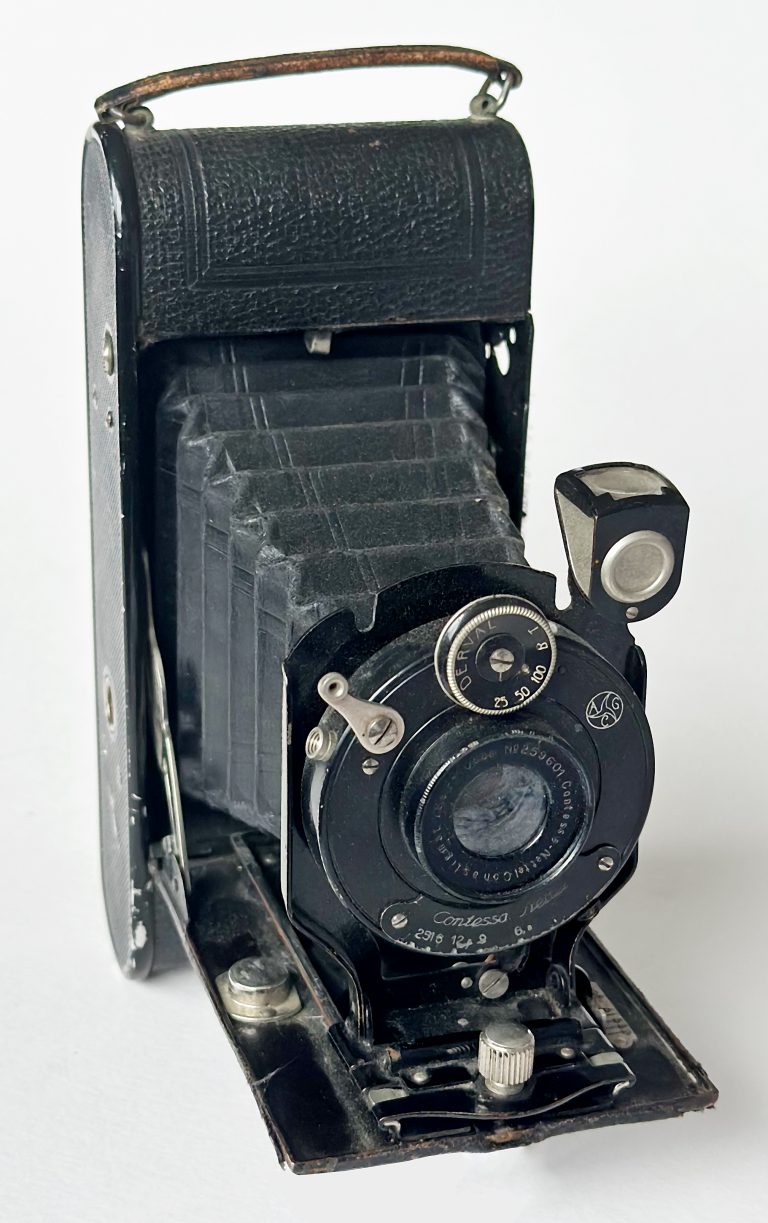
1930 Voigtlander AVUS
This 6.5 x 9cm camera is one of a series of folding plate cameras made by Voigtlander from 1913 to 1934. These cameras came in both 6.5x9cm and 9x12cm versions. They have double extension bellows and are equipped with Ibsor or Compur shutters, this example has a Compur with speeds from 1 to 1/250th. Also a Jena Tessar 120mm F4.5 lens is fitted. There is a small amount of both rise/fall and lateral shift movement. With my camera are a number of very rare Rada “Rollfilm-Kassettes”.
The name Avus was taken from speedway car racing circuit in Berlin, the first in Germany.

1933 Zeiss Ikon NETTAR 515/2
The Nettar series by Zeiss Ikon was a successful range of self-erecting folding cameras for 120 roll film. Zeiss Ikon always advertised the Nettar series as being for the amateur photographer, however these cameras share many parts with the much more expensive Ikonta series so the build quality is excellent. On this example the lens mounted viewfinder is missing.
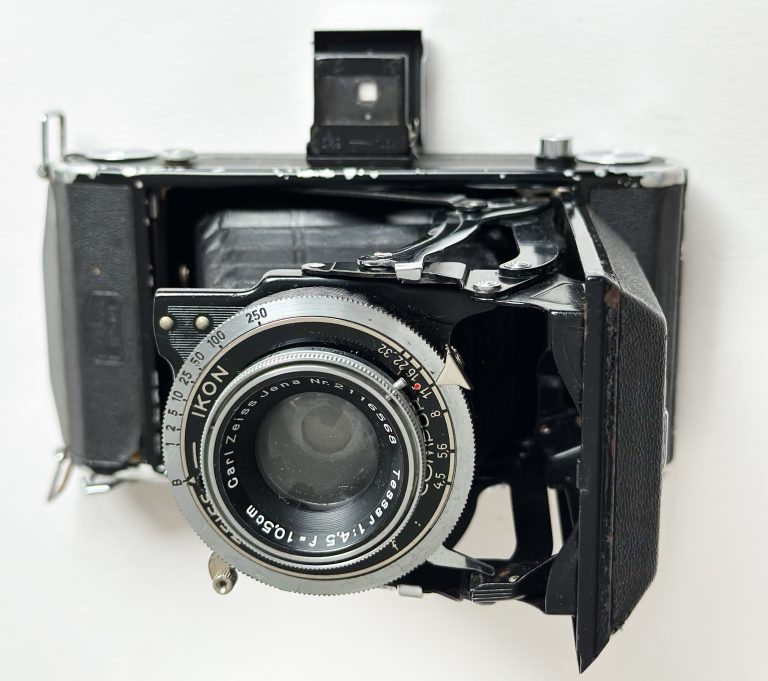
1935 KODAK Retina 1 (118)
Although branded a Kodak, these were made in West Germany by Nagel Camera Werks AG which Kodak had acquired in December 1931.
This camera was used by Sir Edmund Hilary on his successful first ever ascent of Mount Everest in 1953. The slightly earlier type 117 was the first camera to use daylight loading 35mm cassettes (known as 135) invented by Kodak in 1934.
It has a Compur shutter with speeds from 1/500th to B and T. The Schneider-Kreuznach Xenar f3.5 50mm lens has a reputation for sharpness, albeit uncoated.
In 1953 Sir Edmund Hillary bought his second-hand and only modified it slightly so it could be wound-on with gloves. To quote Scott Bilotta “It’s interesting that the Retina was bought second hand. I think that could be a testament to the quality of the Retina series of cameras”.

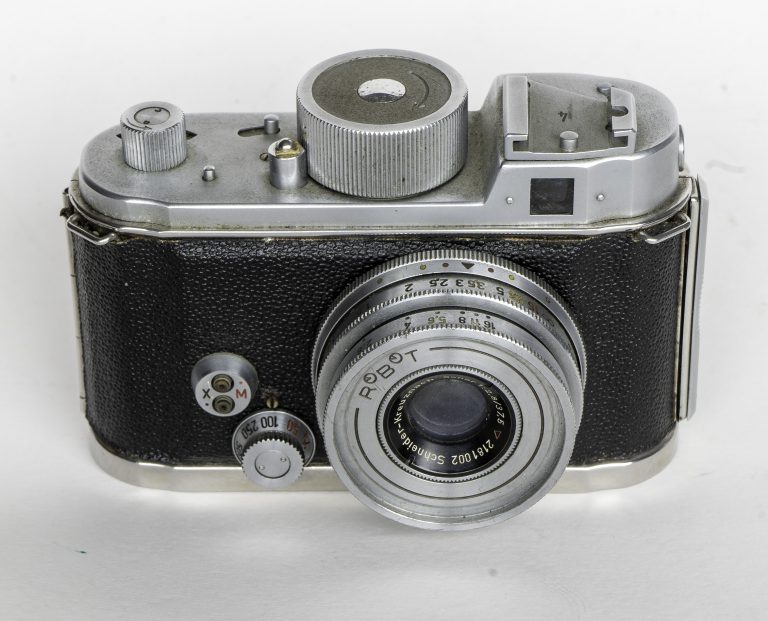
1951 Berning Robot lla
Lorem ipsum dolor sit amet, consectetur adipiscing elit. Ut elit tellus, luctus nec ullamcorper mattis, pulvinar dapibus leo.
1951 KODAK Retina lla
This camera was purchased new by my father in West Africa after he lost his his Agifold in a motor accident.
“The Kodak Retina IIa is a favorite of the long lived Retina series, the epitome of a classic small fast lensed 35mm folder. It is so good due to It’s small size, superb 50/2 Xenon lens, better than average finder, quiet leaf shutter, and the simple straightforward design which translates to pleasurable shooting. The IIa was produced only from 1951 to 1954, yet over 100,000 were produced. In a nutshell, many Retina fanatics feel the earlier Retinas had less of the desirable features, while the later Retinas sacrificed too much size and weight for additional features”.
In the illustration is the original close-up attachment for the camera. There was also a Gossen Sixti exposure meter which clipped into the accessory shoe. This was stolen (along with other photographic items) but I have recently bought another from eBay!

1954 KODAK Retinette
Manufactured from 1954 to 1958. This model was the first of the rigid front Retinettes. Fitted with a Schneider Reomar 45mm f/3.5 lens in a Compur-Rapid shutter it was made in the same factory as the more expensive Retina.

1955 EDIXA Reflex
The first Edixa SLR, originally named the Komet, debuted in 1954 but was quickly renamed due to trademark issues. Early models featured a cloth focal plane shutter with speeds from 1/25 to 1/1000th and B, with slower speeds added in 1955. Cameras offered either a waist level or pentaprism viewfinder and interchangeable M42 screw mount lenses. Later models included a shutter release lock.
Wirgin, founded in Wiesbaden in 1920 by Heinrich, Max, and Josef Wirgin, was sold to Adox in 1936 when the brothers fled Nazi Germany. They later repurchased the company and, by the 1950s, focused on 35mm viewfinder and rangefinder cameras, including the Edinex and Edixa. In 1948, Heinz Waaske joined as a precision mechanic, eventually becoming chief designer and developing an all-new 35mm SLR.
The Edixa Reflex, named to distinguish it from the rangefinder models, was inspired by the KW Praktina and used an M42 mount. Production continued until 1969, with 38 models based on the same body. The Edixa Electronica of 1962, though innovative, was quickly outpaced by Japanese competitors.
Waaske also designed the Edixa 16 and a compact 35mm camera, which the Wirgins declined. He sold the design to Franke & Heidecke, leading to the successful Rollei 35. The Edixa is praised for its mechanical feel and craftsmanship, embodying the charm of classic German cameras.
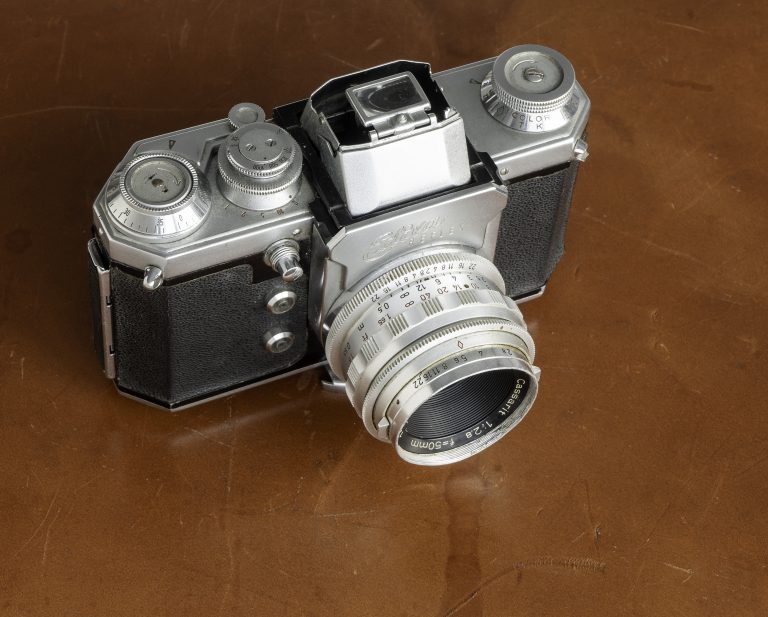
1957 Praktina FX
After the war KW fell under Soviet control in the DDR, and when Charles Noble was imprisoned, the authorities asked Zeiss engineer Siegfried Bohm to restart production of the Praktiflex. However Bohm also came up with this camera which came out in 1953. However the Praktina failed in the brief to make an affordable camera for the masses, i.e. the Praktica so production only lasted until 1960.
According to Alberto Taccheo (praktina.com) “This camera is of great historical importance and represents a milestone in the development of the 35mm single-lens reflex cameras. Praktina was the first 35mm single-lens reflex camera with the full interchangeability of lens, viewfinder, focusing screen, camera back and also the connection for a motor drive. With its lenses and accessories the Praktina is the first example of a professional 35mm SLR camera system. It has held for some years an outstanding position into specialized applications due to its original accessories as electric motor drive with remote control, spring winder, 17m magazine back and others scientific devices.”
The earlier FX was superseded by the IIa in 1958 which had geometric shutter speeds, new automatic lenses and a single flash socket with a selector lever under the rewind knob.
My FX is fitted with the Carl Zeiss Jena Biotar 58mm f/2 lens. This is the same lens as the Contax/Pentacon F and has a good reputation. The lens mount is a unique advanced breech lock system which is highly accurate. In fact it has been described as “the perfect lens mount”. It has an interchangeable finder system with either a pentaprism, waist level finder and other accessories which can be seen in the image below from the official instruction manual. There is also an optical finder which is useful if a waist level finder is attached, or screen blackout needs to be avoided.
Wheres the leading system camera of the time was the Exakta, the Praktina was different in that it was a clean sheet design, not “a continuous attempt to update a 1930s camera without making fundamental changes” (Samuel Tang). As a system camera it had no peers and may well have inspired the system approach adopted by Nippon Kugaku in its 1959 Nikon F.
I must say I was blown away by the build quality of this camera. The viewfinder is surprisingly bright and it even has a split-image rangefinder. It all seems to work as it should. The semi-automatic lens does need a twist of a ring on the lens to return to full aperture after taking the shot, and the mirror only returns when wound on, but it is still a good handling camera which feels nice to hold, not unlike the Nikon!

1959 Pentacon F
This is another interesting and important camera. According to ZeissAutumn2001 “The success of Contax/Pentacon is not reflected by impressive sales figures according to the Statistical Yearbook of the GDR, a total of only 186.990 cameras was made in the 13 years of its production. The design of this legendary camera, however, prevailed and left its traces in the early Japanese cameras with fixed prism and subsequent models. The achievement of Wilhelm Winzenburg, designer of the SLR Contax, is commemorated in this way”.
This camera exists due to pre-war plans by Zeiss Ikon to build a competitor to the Ihagee Kine-Exakta and KW Praktiflex SLR cameras. It was initiated by Dr. Heinz Küppenbender whose engineering background lead to his appointment as chief designer under Emanuel Goldberg. He ordered his team, headed by Hubert Derwin, to base the new camera, to be called the ‘Syntax’*, on the existing Contax. In the end, only a few prototypes or mockups were built. Sadly the plans included a pentaprism which would have made it the worlds first SLR to have such a feature. The image below is allegedly from a book by Alexander Schulz called the “Spiegel-Contax” (Reflex Contax) and it looks very similar to my camera.
After the war the Syntax project was terminated as everything had been destroyed by the bombing of Dresden. However, now under Russian control, the idea for Zeiss to produce a ground breaking SLR had survived and Wilhelm Winzenburg was put in charge of the project. Unlike Hubert Derwin he did not have to base the camera on the Contax. The vertical focal plane shutter of the Contax (which would have interfered with the pentaprism) was replaced by a horizontal shutter like that fitted to the Exakta/Praktiflex. Other than that there are some design similarities between the pre and post war cameras. Helping Winzenburg was Walter Hennig and the new camer, called the Contax-S (S=Spiegel or mirror) was presented at the 1949 Leipzig Fair. It went on sale in the US in 1950. It’s claim to be the world’s first production pentaprism SLR was disputed by the Italian Rectaflex which came out in 1949.
The Carl Zeiss Foundation in West Germany (at the time of the Iron Curtain) took the Dresden Zeiss to court in the SLR export markets for using the Contax name. This lead to cameras being renamed Pentacon for these markets, a name which was to envelope both Praktica and Ihagee during the 1970s.
* An interesting fact is that the proposed Syntax SLR has a newly designed bayonet lens mount. In the 1970s there was a brief period when Zeiss and Asahi collaborated and the Syntax lend mount became the new Pentax K mount of 1975!

1962 Ilford Sporti
This was my first ‘proper’ camera (after a box camera). Although branded by British Ilford, it was, in fact, made by Dacora in West Germany. Taking 120 film and making 6 x 6 negatives, it was very basic with zone focusing with a minimum distance of 5 feet. There are two apertures , f11 and f8. The shutter speed is fixed at 1/50th.

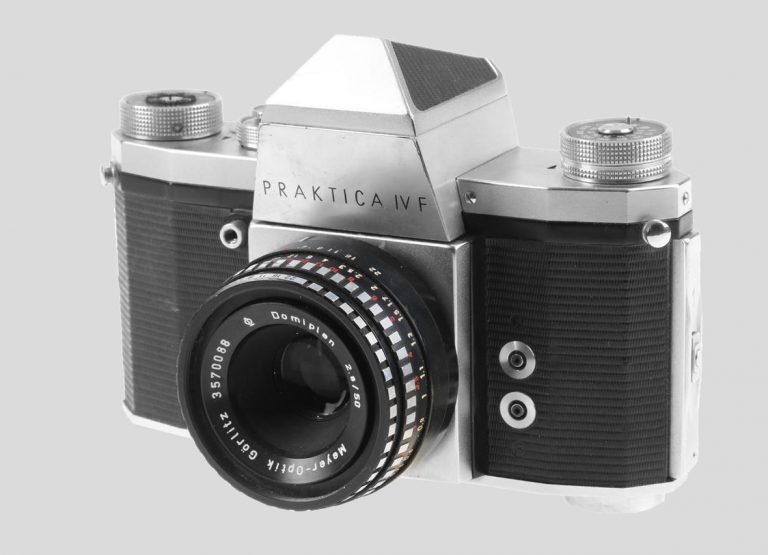
1964 Praktica IVF
Made by VEB Pentacon in East Germany, this my first serious camera, the cheapest SLR available at the time.
It was fitted with an instant return mirror, differentiating it from the Practica IV. Speeds were 1/2-1/500 +B, and the lens fitted was a Meyer Domiplan which I described as having the resolution of the bottom of a beer bottle (I couldn’t afford the better Zeiss Jena Tessar, also 50mm F2.8).
1965 Voigtlander Vitoret D
The Vitoret D was introduced circa 1962 as an inexpensive viewfinder camera from Voigtländer, and was replaced in 1966 with a restyled version featuring squarer body corners. This was discontinued in 1971.
A built-in uncoupled selenium meter is included, with a top-plate display. The scale focusing lens offers only three distance settings: 4.5 feet (portrait), 10 feet (group), and 30 feet (landscape), with each setting displayed in the viewfinder. The Vitoret D was offered with two lens options: the Lanthar f/2.8 50mm or the Vaskar f/2.8 50mm, until 1965 when a Color Lanthar f/2.8 50mm became the only version available.

1967 Minox B
Another claim to fame of the Minox is that it was used to take (illegally) the first photograph of the House of Commons in 1940 (see below).
Walter Zapp was born in Latvia, and although his education was quite ordinary, it fortunately didn’t affect his natural inventiveness and mechanical talents. He had an interest in photography and when he met and befriended art photographer Nikolai Nylander he made his first invention, a print cutter. He developed an obsession with the potential of an extremely small camera with ‘big’ results! In 1925 he encountered an early Leica. He subsequently sent sketches and ideas for his small camera to Oskar Barnack but he never responded. With encouragement from Nylander he developed his small camera further, making a wooden mockup 13 x 28 x 75mm in size. This lead to full-scale drawings.
Eventually arrangement were made to produce the camera at VEF, a radio manufacturer in Riga, Latvia. The first model, subsequently to be known as the “Riga” or Minox I, came out in 1937 and was produced until 1944. The model II was made from 1948 in West Germany. A major improvement was the lens which was redesigned with help from Leitz. However problems with the 5-element design lead to a further redesign, the 4-element Complan of the model III of 1951. This lens is fitted to my 1967 Minox.
This Minox, apart from the aforementioned fixed aperture (f/3.5) 15mm Complan lens also has a shutter with speeds from 1/2 to 1/1000s & B. Focussing is from 8” to infinity and the camera is fitted with a useful chain to measure the distance from the subject. The selenium meter, a feature of this model, not surprisingly no longer works. The film is 9mm in special cassettes, and the image size is 8 x 11mm. The cameras has built-in green and neutral density filters. It also has a neat leather case. Films in the 8 x 11 format are only made by Blue Moon in Oregon, USA. Fortunately in the UK MS Hobbies in London supply and develop Minox film stock.
The cigarette packet photographed with my Minox is older than the camera! It belonged to my maternal grandfather, Rene Cordier. He died in 1959 aged only 57 but my Grandmother kept the unfinished packet, and I took it when she died in 1974. He allegedly enjoyed a single cigarette after his dinner!

1971 Leicaflex SL
The original Leicaflex came out in 1964. Leitz sales were suffering from the Japanese competition in SLRs. Rangefinder cameras were losing favour and were in decline, so Leitz decided to manufacture their own SLR. There were 3 models, the Leicaflex, the Leicaflex SL and the Leicaflex SL2. However solid, well-made and dependable they were, in the words of Casual Photophiles Nick Clayton “The Leicaflex failed to convert Leica’s rangefinder users to the SLR, and it failed to convert users of Japanese SLRs to the much more expensive Leica camera. Leica had simply misread the market”.
The original Leicaflex featured a shutter speed range of 1 second to 1/2000 a second, an external CdS exposure light meter and a new range of R bayonet lenses. The camera body was based on the Leica M. The viewfinder featured match-needle exposure setting and was notable for its clarity, it showed the shutter speeds along the bottom.
In 1968 Leitz answered initial criticisms by bringing out the SL with TTL spot-metering. Focussing was by microprisms, the circle of which represented the actual area being metered. The build quality of all the cameras was impeccable, although the later SL2 (which featured a better meter) was thought to be less well built. The shutter sound is legendary, particularly for an SLR with the then obligatory instant return mirror. Apparantly, poor sales meant that each camera was sold at a loss. The SL2 was discontinued in 1976 with the introduction of the joint Minolta/Leitz developed R3 based on the Minolta XE.
Ironically it was Leitz which developed the first auto-focus system, but they concluded that manual focus was more accurate and sold it to Minolta who took the credit (with the Minolta 7000) for introducing the first camera body-based auto-focussing camera system.
